

PBIS in Action: Bangor’s Downeast School Showcases Successful PBIS Implementation and Inclusive Pilot Program
This spring, two educators from Tasmania, Australia, traveled across the globe to Maine through the Hardie Fellowship Program, an experience that allows Tasmanian educators to study educational systems and evidence-based practices in the United States. One of their stops was the Bangor School Department’s Downeast School, which has become a powerful example of how Positive Behavioral Interventions and Supports (PBIS) and inclusive education practices can work together to improve outcomes for students.
Melissa Didham, an Instructional Specialist from Tasmania focused on early literacy instruction, and Sarah Smith, an Advanced Skills Teacher leading Multi-Tiered Systems of Support (MTSS) alignment work in Tasmania, are studying how schools can systematically integrate academic, behavioral, and engagement supports for students requiring additional intervention.
They visited Downeast School, as well as other schools in Regional School Unit 22, Portland Public Schools, and the South Portland School Department, as part of this work.
Serving approximately 300 students in prekindergarten through grade 3, Downeast School is a Title I school, as many of its students and families face socioeconomic challenges. Four years into implementing PBIS, a nationally recognized, evidence-based framework for improving school climate, the school has seen measurable improvements in student achievement, attendance, and behavior. The work has also resulted in a stronger, more collaborative learning environment for both students and staff. For Downeast School Principal Sarah Vickers, PBIS has provided a framework for building systems that meet the unique needs of the school community, while empowering educators to continuously improve their practice. Vickers explained that the Bangor School Department provided opportunities for schools to engage in PBIS work, and each school administrator has had the flexibility to implement the framework in ways that best fit their building. This strong district support and staff collaboration has been critical to the success of PBIS at Downeast School.
“I knew what the building needed,” Vickers recalled of Downeast School’s early PBIS work. “This is how we can continue to do what’s best for students.”
That mindset has also helped position Downeast School to become one of the Maine Department of Education’s (DOE) Inclusive Education Model Pilot Schools, an initiative designed to make learning more accessible for all students, including those with Individualized Education Programs (IEPs). Experts involved in the pilot say PBIS creates a strong foundation for schools seeking to build more inclusive learning environments. Now at Downeast School, inclusive practices are intentionally embedded into instructional scheduling and classroom routines. Rather than removing students from classrooms during core instruction, educators work to ensure all students learn together alongside their peers. Additional support is provided during independent work time and outside of direct instructional periods.
The combination of PBIS and inclusive education practices has led to measurable improvements across the school. During the 2025-2026 school year, Downeast School increased its Tier 1 PBIS implementation score from 60% in the fall to 68% in the spring, as measured by the Tiered Fidelity Inventory (TFI). As implementation strengthened, office referrals decreased from 219 during the 2024-2025 school year to 84 during the 2025-2026 school year.
Attendance indicators have also improved. Downeast School’s average daily attendance is currently 91%. Over the past year, the school has seen a decrease in the percentage of students identified as chronically absent (down four percentage points), the percentage of students identified as truant (down eight percentage points); and the percentage of students approaching chronic absenteeism (down 15 percentage points).
Educators say Downeast School’s strong PBIS framework, coupled with inclusive practices, has been transformative. Students receiving special education services are demonstrating academic growth alongside increased success among the entire student body. Some students who previously needed additional one-on-one support are asking not to be pulled from class so they can continue learning alongside their peers.
Downeast School’s approach also emphasizes intentional goal setting for students, particularly those receiving special education services. Even when students are working below grade level, staff focus on identifying prerequisite skills and bridging gaps that help students move toward grade-level expectations.
First-grade teacher Barbra Clewley, who is also a Maine PBIS trainer and coach, said the work requires educators to rethink how they approach student support.
“Instead of saying, ‘What does that student need to do differently?,’ it’s, ‘What can I do differently to help that student?’” Clewley said.
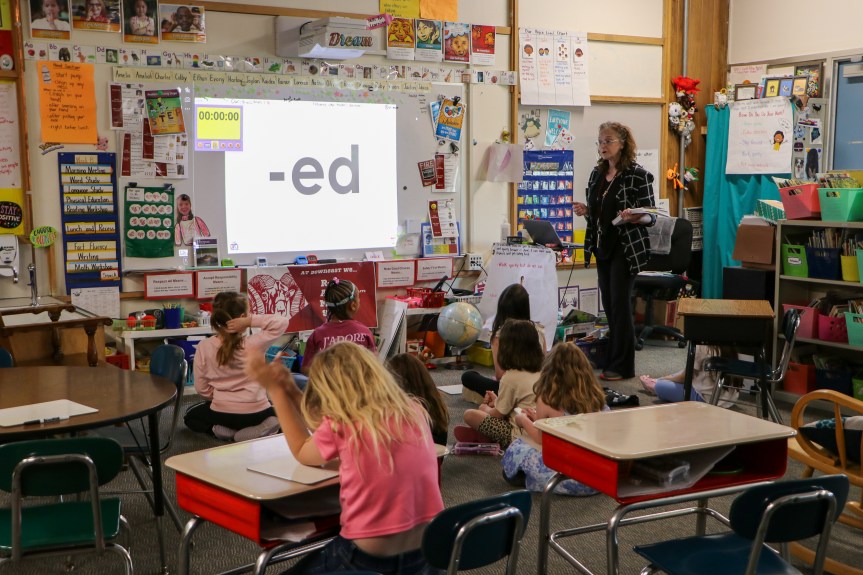
Clewley explained that both PBIS and inclusive education practices encourage educators to reflect on and adapt their own practices rather than expecting students to change first.
“You’re not trying to change your students,” Clewley said. “You’re trying to change what you do as a teacher. That’s where they build really well together.”
Academic data further highlight the progress of Downeast School students. On the grade 3 Maine Through Year Assessment, the number of students performing at or above expectations in mathematics increased by 68.4% from the spring of 2025 to the spring of 2026. In reading, the number of students performing at or above expectations increased by 86.7%. Additionally, on average, students demonstrated strong, healthy progress (an RIT gain of 15 points) when comparing their progress between testing periods. From kindergarten through grade 3, 57% of students made a year’s worth of growth in reading in 2026, a five-percentage-point increase from spring of 2025. Among students receiving special education services, 36% made a year’s worth of reading growth this year.
Vickers said maintaining healthy relationships among staff, encouraging collaboration, and creating a culture where educators feel comfortable trying new strategies have all been critical to Downeast School’s continued growth. Vickers, who has a background in special education, has remained steadfast in her vision for fully implementing PBIS through intentional, student-centered practices, while fostering an environment where educators work together to meet student needs.
“Our teacher leaders are essential to our success,” Vickers said. “They help build staff capacity, foster collaboration, and ensure our improvement efforts remain focused on students.”
PBIS is a nationally recognized, evidence-based framework designed to create positive school climates by teaching and reinforcing clear behavioral expectations. It helps schools to improve student behavior, promote academic success, and build supportive environments where all students feel safe, respected, and empowered to thrive. To learn more about PBIS in Maine, visit the Maine DOE website.
To learn more about the Maine DOE Inclusive Education Model Pilot Schools initiative, visit this Maine DOE Newsroom article.
This article was developed in collaboration with the School Department and the Maine PBIS program, a partnership between the Maine DOE Office of Special Services and Inclusive Education and the University of Maine System. This article is part of a series highlighting the successes of Maine schools that are in the process of implementing, or that have implemented, PBIS in their schools. To submit a good news story to the Maine DOE, please fill out the good news submission form.
Related
Legal Disclaimer:
EIN Presswire provides this news content "as is" without warranty of any kind. We do not accept any responsibility or liability for the accuracy, content, images, videos, licenses, completeness, legality, or reliability of the information contained in this article. If you have any complaints or copyright issues related to this article, kindly contact the author above.
